Formaldehyde Testing in Singapore: S$30 Meters vs Real Labs (2026)

Published 14 July 2026
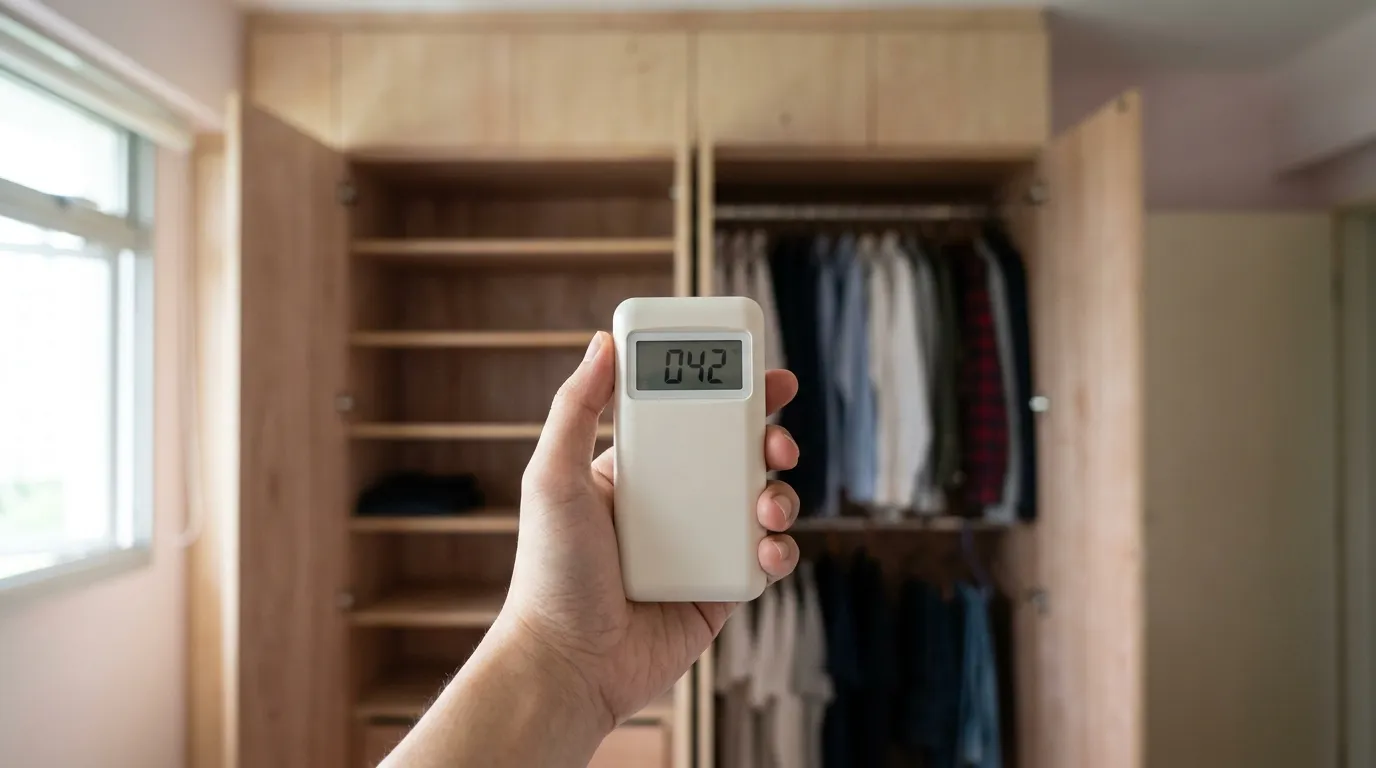
After a renovation, everyone wants the same thing: a number. The market is happy to sell you one — a S$15 Shopee gadget, a S$328 meter, a S$0 “free test” from the company that also sells the cure, or a S$400+ professional visit. These numbers are not equally real. This is spec-sheet and published- evidence research (July 2026), not lab testing of our own, and the short version is: the cheap tier measures nothing, the mid tier measures trends, and the only number that survives an argument with your contractor comes from a pump and a laboratory.
The S$30 tier: readouts, not measurements
The sub-S$60 handhelds all over Shopee and Lazada — the ones showing HCHO, TVOC and PM2.5 on one cheerful screen — use a diffusion-sampled metal-oxide sensor that responds to broadly everything. In 2019, Shanghai’s Institute of Measurement and Testing lab-tested 41 of them, bestsellers from nearly 20 brands. All 41 failed. Some read zero in rooms that contained formaldehyde; others read higher in the cleaner rooms. Smart Air’s party trick makes the mechanism obvious: hold an orange next to one and watch it alarm — citrus terpenes, cleaning sprays, even peanut butter read as “formaldehyde” to a sensor this unselective. A number from this tier isn’t conservative or approximate. It’s noise with a decimal point.
Related deadpan observation: your nose is better instrumentation than any of these. Most people begin to smell formaldehyde at roughly the concentration health guidelines flag (~0.1 mg/m³) — so “the wardrobe still smells” is genuinely more diagnostic than a S$30 readout. The nose’s known bug is fatigue: it stops registering a constant smell within minutes. Step out for half an hour, walk back in, and trust the first ten seconds.
The tier that’s actually decent: electrochemical
The real step up is a dedicated electrochemical formaldehyde cell — the Sensirion SFA30 class of sensor. Independent lab evaluation (Sensors, 2023) found these accurate to about ±4 ppb with R² above 0.95 against reference instruments — genuinely respectable. The 2025 follow-up study added the fine print: readings skew with temperature and humidity (relevant, Singapore), outdoor gases like NO2 and ozone can suppress the signal almost entirely, and cheaper electrochemical cells false-alarm hard on alcohols — one tested sensor over-read by 118% in the presence of methanol. Practical translation: don’t measure right after wiping down surfaces with cleaning products, and treat any single reading as a data point, not a verdict.
What this tier is honestly good at is trend, not truth: the absolute number may be off, but “half of last month’s reading, measured the same way in the same spot” is real information — exactly what you want while airing out a new flat.
What the tiers cost in Singapore
| Tier | Example | Price | What the number is worth |
|---|---|---|---|
| Shopee gadget | generic HCHO/TVOC/PM2.5 handheld | S$15–60 | Nothing — 41/41 failed the regulator’s test |
| Electrochemical meter | Temtop M2000 (testmeter.sg) | S$328 | Indoor trend tracking; absolute value indicative |
| Dedicated pro handheld | Tenmars TM-802 | S$458 | Same class, TWA/STEL logging |
| Removal company “free test” | bundled with treatment quotes | S$0 | A sales visit — see below |
| Professional home test | multi-point, calibrated instrument | ~S$280–450 | Decent — if they name the instrument |
| Lab-grade sampling | DNPH cartridge + HPLC analysis | quote; 3–5 days | ±5% — the dispute-grade number |
Two absences worth knowing: the mail-in passive sampler kits common in the US (expose a badge for days, post it to a lab) are effectively unavailable to Singapore buyers — the local equivalent is an on-site professional visit. And there is no NEA or government home-testing service, free or paid; the SS 554 indoor air standard everyone quotes formally covers air-conditioned commercial buildings, not homes — for your flat it’s a benchmark, not a certification anyone can issue.
The free-test problem
Most “testing” in Singapore is sold by companies whose actual product is the removal treatment — the meter that discovers your problem belongs to the company selling the fix, a pattern we covered in our comparison of those services. Even the industry says the quiet part: one removal firm’s own guide warns that cheap tests “often use only a low-grade VOC meter without specific formaldehyde measurement.” If you’re paying for a test — or accepting a free one — the two questions that sort professionals from salesmen: which instrument, exactly (model name, and whether a calibration certificate exists), and in which units the report will state results (mg/m³ and ppm differ by roughly a factor of 0.8 at these levels; a report that mixes them up wasn’t written by a scientist).
Who should skip testing entirely
- Most households. If the flat smells, you already know the answer: ventilate, run the heat-and-airflow playbook, and spend the meter money on carbon filters instead. Testing doesn’t lower anything.
- Buy the S$328 meter if you’ll actually use the trend: same spot, same time of day, weekly, for months. One reading tells you almost nothing; the curve tells you when to stop worrying.
- Pay for lab-grade when the number has a job: a newborn moving in, symptoms you’re attributing to the flat, or a dispute with your contractor where “±5%, laboratory analysis, documented chain” is what makes the report worth the paper.
Frequently asked questions
Are cheap formaldehyde detectors accurate?
No. The sub-S$60 handhelds use unselective metal-oxide sensors; when Shanghai’s measurement institute lab-tested 41 bestselling units, every one failed — some read zero in formaldehyde-laden rooms, others read higher in cleaner air. They also alarm at citrus, alcohol and cleaning sprays.
How much does professional formaldehyde testing cost in Singapore?
Roughly S$280–450 for a multi-point home visit with a calibrated handheld instrument. Lab-grade testing — a pump drawing air through a DNPH cartridge, analysed by HPLC over 3–5 days — costs more and is quote-based, but is accurate to about ±5% and is the version that stands up in a dispute.
What is a safe formaldehyde reading?
The WHO indoor guideline is 0.1 mg/m³, about 0.08 ppm, over 30 minutes — the benchmark most Singapore providers quote. Check which unit your meter or report uses; mg/m³ and ppm are different scales, and mixing them up changes the verdict.
Is a free formaldehyde test worth taking?
Treat it as the sales visit it is — the company testing your air sells the treatment, and cheap handheld readings are easy to present alarmingly. Take the free number if offered, then ask which instrument produced it and whether it has a calibration certificate before spending anything on the strength of it.