How to Remove Formaldehyde After Renovation (What Actually Works)

Published 14 July 2026
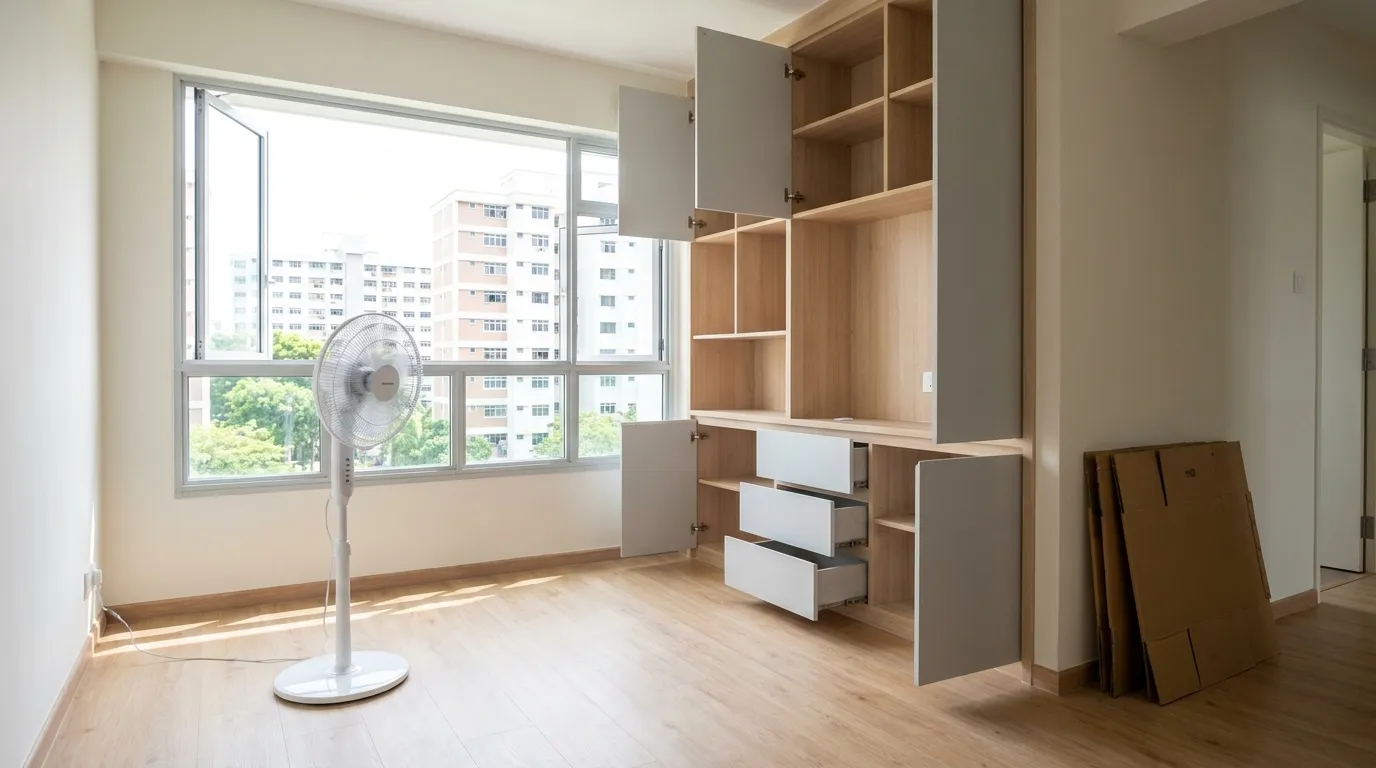
Your renovation is done, the carpentry looks beautiful, and the flat smells like a chemistry lesson. That smell is mostly formaldehyde off-gassing from the urea-formaldehyde glue inside your new plywood and particleboard — and Singapore’s heat and humidity push it out faster than almost anywhere else. The good news: the same physics gives you real, mostly-free ways to speed it up. This guide ranks them by evidence, covers what doesn’t work (plants, mostly), and tells you when it’s worth paying a professional service instead.
Why your new carpentry smells — and for how long
Built-in wardrobes, kitchen cabinets and TV consoles are made from pressed-wood boards bonded with urea-formaldehyde resin. The resin keeps releasing formaldehyde gas as it cures and breaks down — the US EPA puts the emission half-life at roughly 1.5 to 2 years, with the heaviest off-gassing in the first few months, decaying steadily after that.
This isn’t a niche worry: rising formaldehyde levels in new Singapore homes got a full CNA Talking Point episode in April 2026, and Parliament took questions on it from five MPs. Two Singapore-specific notes from all that attention. First, heat and humidity accelerate emission — your flat off-gasses faster than the same carpentry would in a temperate climate, which is unpleasant now but means it finishes sooner. Second, regulation hasn’t caught up with the boards: interior paints with added formaldehyde are banned from January 2026, but composite wood products are covered only by voluntary industry guidelines — the Ministry said so in Parliament — so no rule sets emission grades (E0/E1) for the plywood in your carpentry. That’s why the smell varies so much between contractors, and why “E0” on a quote is a claim, not a certification you can look up.
What actually works, ranked by evidence
1. Ventilation — still undefeated
Boring, free, and the one method every credible source agrees on — when Parliament asked what residents with formaldehyde problems should do, the Ministry’s answer was to improve ventilation with open windows and fans. The gas your boards release has to go somewhere; your job is to make sure that somewhere is outside.
- Cross-ventilate: open windows on opposite sides of the flat, doors between them open.
- Point a fan out the window — you’re exhausting indoor air, not circulating it. A cheap pedestal fan running at the window outperforms an expensive purifier standing in the corner.
- Open every cabinet, wardrobe and drawer. The highest concentrations are inside closed carpentry — the exact places a quick airing never reaches. Leave them gaping for weeks, not hours.
- Bugs are the usual objection; magnetic insect mesh is the S$20 answer.
2. Heat: the cookout
Emission rises with temperature, so you can deliberately bake the gas out. The routine: close the windows and let the flat heat up through the hottest part of the day (aircon off — this is the one time Singapore afternoon heat works for you), then come back in the evening and flush everything out with full cross-ventilation. Repeat over days or weeks. It’s the closest thing to “fast-forwarding” the off-gassing curve, and it’s the most consistently recommended fix from people who’ve actually been through it. Don’t live in the flat while running cookouts, and skip the space-heater variants — the midday sun does the job without warping your new laminate.
3. Activated carbon — works while it’s fresh
HEPA filters don’t catch gases; activated carbon does — until it saturates. If you run a purifier, it needs a real carbon filter (not a thin mesh coated black), and that filter needs replacing every one to two months during the heavy off-gassing phase, which is the part of the pitch the purifier box doesn’t mention. Carbon sachets inside cabinets work on the same principle at a much smaller scale: some help, close to the source, no substitute for airflow. We’ve done the carbon math on which purifiers genuinely handle formaldehyde — including the Dyson question.
4. Seal the source
The most defensible thing the professional industry sells is also available as a DIY step: coating the raw, unlaminated surfaces — cut edges, cabinet backs, drawer undersides — so less gas escapes. Laminated faces barely emit; the raw edges do. DIY formaldehyde-sealing sprays exist locally (one supplier, uCoate, publishes an SGS Singapore lab result — more documentation than most full-service companies offer), and Shopee removal gels sit in the same family: partial, source-adjacent, better than misting the air. If you’re still choosing carpentry, this is also the argument for paying for better boards now rather than treatment later.
What doesn’t work (or barely)
- Plants. The NASA “air-purifying plants” study was done in sealed chambers; follow-up research estimates you’d need hundreds of plants per room to match one open window. Buy the monstera because you like it.
- Ozone generators. Ozone is itself a lung irritant — the US EPA advises against using ozone generators in occupied spaces, and it doesn’t stop boards from off-gassing. Some paid services still sell it; we’d pass.
- One-off misting of the air. Anything sprayed into the room and not onto the raw wood treats today’s air, not tomorrow’s emission.
- Fragrance. Candles, diffusers and “new home” sprays add chemicals on top of the one you’re trying to remove.
Should you test?
Carefully. The cheap handheld detectors on Shopee are notoriously unreliable — in one regulator’s sweep, Shanghai’s market authority tested 41 consumer formaldehyde detectors and all 41 failed on accuracy. Readings that swing wildly, units nobody checks (mg/m³ versus ppm), no calibration. If a number matters to you — a newborn, an asthmatic, a dispute with your contractor — pay for a proper assessment with a named instrument rather than trusting a S$30 gadget; we’ve broken down the testing options and what they cost. The reference point: the WHO indoor guideline is 0.1 mg/m³ (0.08 ppm), the same figure Singapore’s SS 554 code uses for air-conditioned buildings.
When it’s worth paying someone
A professional treatment can knock down the acute spike, seal raw surfaces properly, and give you before-and-after numbers — what it can’t do is finish two years of off-gassing in one afternoon, whatever the brochure implies. The honest use case: you’re moving in soon (a lease ending, a baby coming) and need weeks of progress in days, or the DIY route has stalled. Published prices run roughly S$350–525 for a 4-room flat among companies that print prices at all — only four of nine do. We compared all nine, their methods and their fine print, in our formaldehyde removal services guide, including the questions to ask before you book.
Frequently asked questions
Can we sleep in the flat right after renovation?
If the smell is strong, better not to — especially for children, pregnant women and anyone with asthma. Run ventilation and cookout cycles for at least a couple of weeks first, keep bedroom wardrobes open and airing, and move in once the smell has dropped from "obvious" to "faint near the carpentry."
Do plants remove formaldehyde?
Not meaningfully. The NASA study behind the claim was done in small sealed chambers; at room scale you would need hundreds of plants to match the effect of one open window. Ventilation does in minutes what a plant does in weeks.
Do air purifiers remove formaldehyde?
Only with a substantial activated carbon filter — HEPA alone catches particles, not gases. Carbon works until it saturates, which during heavy off-gassing means replacing filters every 1–2 months. A purifier helps the room it sits in; it does not stop the boards from emitting.
How do I know when the formaldehyde is gone?
Your nose is a rough guide — most people smell formaldehyde around the WHO guideline level, so "no smell with cabinets open" is a decent everyday signal. For a number you can rely on, use a professional assessment with a named, calibrated instrument; cheap consumer detectors have failed regulator accuracy tests wholesale.