Do Air Purifiers Remove Formaldehyde? What to Buy in Singapore (2026)

Published 14 July 2026
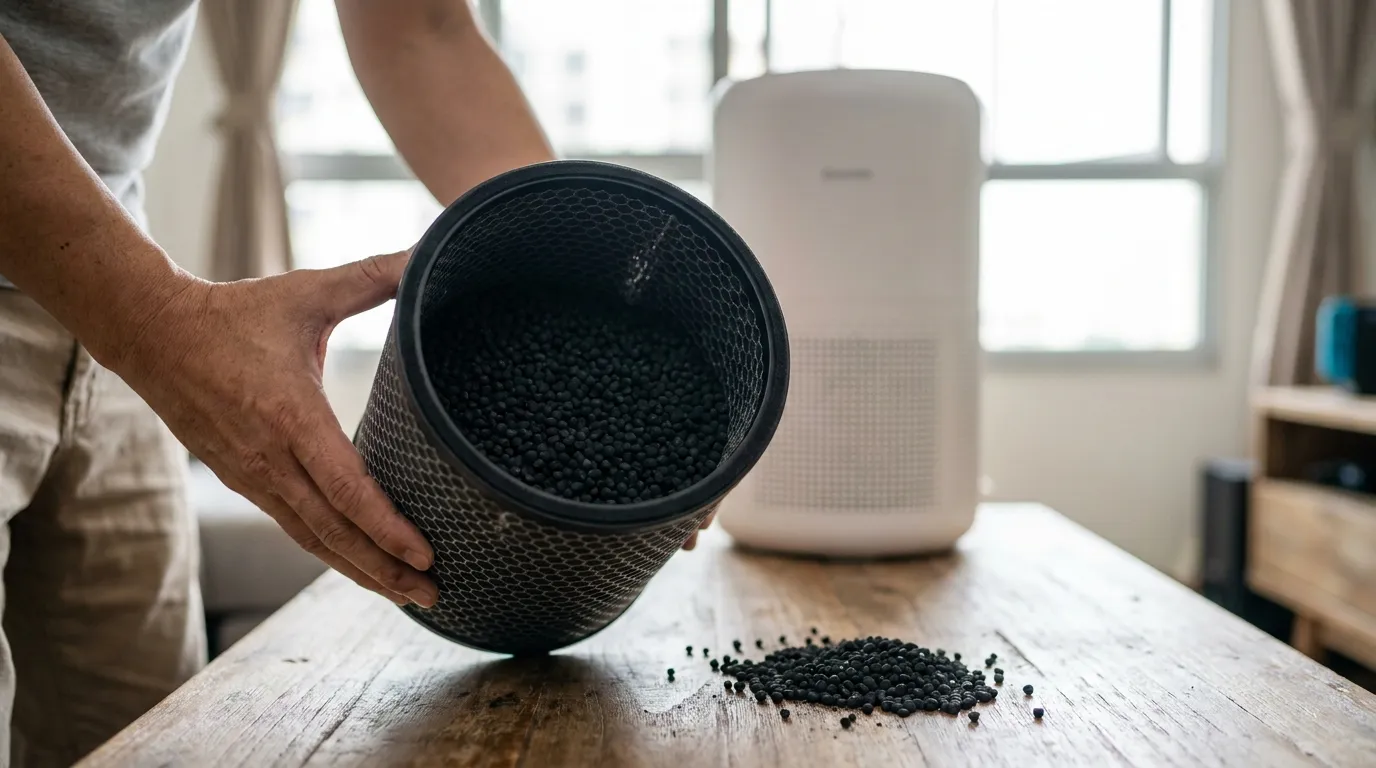
Short answer: yes, if the purifier contains enough activated carbon, and no, a HEPA filter alone does nothing — HEPA catches particles, and formaldehyde is a gas. The useful spec is therefore the weight of carbon in the filter, in grams. Here’s the part that makes this article necessary: almost every purifier sold in Singapore claims to “remove formaldehyde,” and almost none of them will tell you that number. This is spec-sheet research, not lab testing of our own — every figure below comes from the manufacturers’ published pages or named independent testers, checked in July 2026.
How a purifier removes a gas (one paragraph)
Activated carbon adsorbs VOCs — one gram carries roughly 500–1,500 m² of internal surface area, and independent testing (Smart Air cleared a room of pure formaldehyde in about 25 minutes with ~500 g of plain carbon) shows it genuinely works. The catch is that carbon fills up. Once saturated it removes nothing, silently — the fan spins on, the app stays green. So the two specs that matter are grams of carbon (how long it lasts) and replacement cost (what it costs to keep working). Everything else on the box is particle spec, which is a different job.
The carbon table, Singapore prices
Sorted by the only spec that predicts formaldehyde performance. “Not published” means we checked the official SG product page and the number is absent — while the formaldehyde claim is present.
| Purifier | Price | Carbon mass | Replacement filter | 2-yr filter cost* |
|---|---|---|---|---|
| Xiaomi 4 Pro | S$369 | 650 g (published) | S$69.90 / 6–12 mo | S$140–280 |
| AirFanta 3Pro (carbon) | S$195 | 600 g per set (published) | S$84 / 4–8 mo | S$252–504 |
| Xiaomi 4 | S$221 | 500 g (published) | S$49 / 6–12 mo | S$98–196 |
| Dyson TP09 Formaldehyde | ~S$799 promo | not published (+ catalytic layer) | S$89 / 12 mo | S$178 |
| Philips AC3220 | ~S$555 | not published | S$119 / 12 mo | S$238 |
| Cosmo Prime | S$299 | not published | S$70 / 12–18 mo | S$70–140 |
| Sterra Moon | S$189 | not published | S$49.50 / ~6 mo | ~S$198 |
| IKEA STARKVIND + gas filter | S$189 + S$25 | not published | S$25 / 6 mo | S$100 |
| IKEA FÖRNUFTIG + gas filter | S$89.90 + S$15 | not published | S$15 / 6 mo | S$60 |
*Assuming the manufacturer’s own replacement interval; during heavy post-renovation off-gassing, expect the short end or sooner. Prices are July 2026 and move with promotions.
Two patterns worth noticing. First, the only brands that publish carbon weight — Xiaomi and AirFanta — are also the cheapest per gram, which tells you why everyone else prefers adjectives (“premium activated carbon layer”) to numbers. Second, the thin flat gas filters (IKEA’s 2 cm panels, and the carbon coating inside most all-in-one filters) physically cannot hold much carbon — cheap to run, quick to saturate. A claim without a gram figure is a claim, not a spec.
The Dyson question
Dyson’s formaldehyde models (TP09 tower, Big+Quiet BP-series, S$799–1,399 as we write this) add a catalytic filter that “traps and converts formaldehyde into water and CO2” and “never needs replacing.” The chemistry is real — catalytic oxidation over a cryptomelane-type coating — and Dyson backs it with third-party chamber tests under China’s GB/T 18801 standard, whose own fine print adds “results may vary in practice.”
Now the spec-sheet reading. “Never needs replacing” covers only the catalytic layer: the HEPA+carbon filter remains an S$89-per-year consumable on the towers. No independent lab has verified the catalytic filter’s real-room formaldehyde performance or the onboard sensor’s accuracy — and Dyson’s own community forum carries threads of owners whose formaldehyde readout sits at 0.000 while a separate meter disagrees. Independent testers who measured overall cleaning power weren’t kind: Smart Air dug Dyson’s own formaldehyde CADR of 56 m³/h out of its China listings, showed a machine a fifth of the price clearing formaldehyde with 500 g of ordinary carbon, and titled their review accordingly; HouseFresh clocked the TP07 behind a US$99 Levoit. The fair conclusion: Dyson’s formaldehyde machines are competent, beautifully instrumented purifier-fans whose headline feature solves a problem plain activated carbon already solves — at three to four times the price of the carbon.
The saturation problem — the spec sheet’s quiet lie
Every “replace every 12 months” interval assumes normal air. A freshly renovated flat is not normal air: the boards are pumping out the exact gas the carbon is absorbing, and the filter can saturate in one to two months, not twelve. Nothing warns you — carbon has no indicator light. Smart Air’s field method is the honest one: pull the filter out every week or two and smell the carbon at a few centimetres; a sour, chemical smell means it’s full. Budget for that in the 2-year column above — during the off-gassing peak, the S$49 Xiaomi filter replaced early is doing more real work than any purifier left on autopilot.
Who should skip this
- Anyone who can still ventilate. A S$30 fan pointed out an open window moves more formaldehyde out of your flat than any purifier on this page — the DIY playbook is here. A purifier earns its keep in the room you sleep in with the door closed, aircon on — the one place ventilation stops at night.
- Anyone expecting a purifier to end the problem. It cleans the room’s air; the boards keep emitting for one to two years. If you need the levels down fast and DIY has stalled, that’s the use case for professional treatment — with its own caveats, which we’ve covered.
- Anyone buying the sensor. Consumer formaldehyde readouts — on purifiers and S$30 Shopee meters alike — have a poor accuracy record; we’ve ranked the testing tiers that actually mean something. Buy grams of carbon, not a number on a screen.
The boring pick, proudly: a Xiaomi 4 (S$221, 500 g of published pellet carbon, S$49 filters) for a bedroom, the 4 Pro for a living room, with filters swapped aggressively for the first few months. The AirFanta 3Pro if you want the only published VOC CADR in the market and don’t mind it looking like lab equipment. The Dyson if the display and the fan matter to you and the math above didn’t.
Frequently asked questions
Does a HEPA filter remove formaldehyde?
No. HEPA filters capture particles; formaldehyde is a gas and passes straight through. Gas removal comes from the activated carbon layer (adsorption) or, on Dyson formaldehyde models, a catalytic filter — so a purifier with a thin carbon coating is a particle machine with a formaldehyde sticker.
How often should I replace the carbon filter after renovation?
Far more often than the box says. Manufacturer intervals of 6–12 months assume ordinary air; during heavy post-renovation off-gassing carbon can saturate in 1–2 months. Smell the filter every week or two — a sour chemical smell means the carbon is full and the purifier has quietly stopped removing gas.
Is the Dyson formaldehyde purifier worth it?
The catalytic chemistry is real but independently unverified in real rooms, and its clean-air output has tested behind machines a fraction of the price. You are paying S$800+ for a very good fan, a handsome display, and a formaldehyde feature that 500 g of ordinary activated carbon replicates. Worth it for the fan and finish; not for the formaldehyde.
Can an air purifier fix a formaldehyde problem by itself?
No. Purifiers clean the air in one room while the carpentry keeps emitting for 1–2 years. They are the night-time, door-closed complement to ventilation and heat cycles — and if levels need to drop fast, source treatment (sealing the raw board surfaces) is the step purifiers cannot do.